


The prequel to the 6-part series: Trust Is an Outcome

For thirty years, identity and access management has been about answering one question: can this user get access to this resource?
We built directories, authentication systems, federation, single sign-on, privileged access, and governance around that question. The technologies changed, but the underlying question didn't.
Zero Trust challenged the assumption behind it. But now, the user isn’t necessarily a person. It might be a workload, a device, or an AI agent acting autonomously. And that changes the question. It's no longer just about who gets past the door—it's about how trust is established, measured, verified, and maintained over time.
Trust is an outcome. It isn’t a privilege handed out at login or locked in a static policy. It’s the result of real-time evidence, verified and continuously re-evaluated. Signals and context feed that evidence, and identity is simply the language we use to express it.
At the Identity Underground Summit in Denver, we joined Steven Rennick for a panel called "Looking Ahead: Identity Leaders Predict What's Next." One big theme kept surfacing: Trust. The future of identity isn't just access management anymore…it's trust management. This series makes the case for that shift, breaking it down one question and one open standard at a time.
Three eras, three assumptions about trust
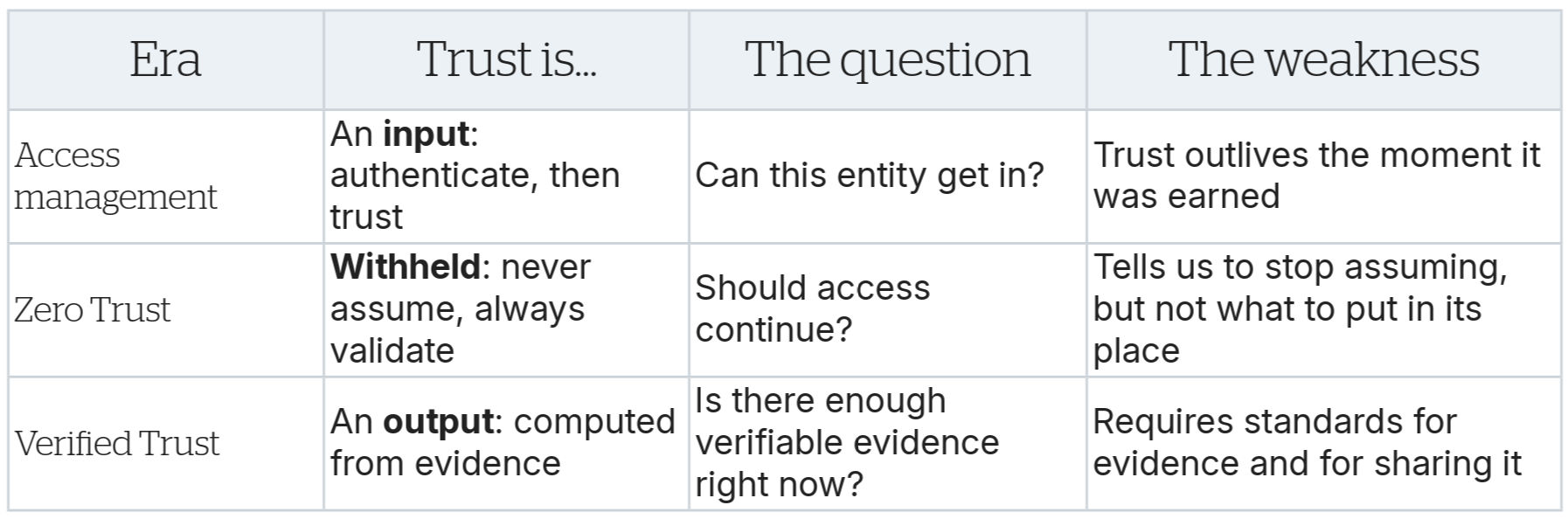
Zero Trust was a much-needed course correction. It killed off the notion that a network location or a single login deserves endless confidence. But "never trust, always verify" is a mindset, not an architecture. Verified Trust asks the next practical question: verify what, expressed how, shared with whom, and re-evaluated when?
The six questions of Verified Trust
Evidence-based trust naturally centers on six main questions for people and non-human identities alike. Each post in this series tackles one question and maps it directly to open standards you can use today or watch closely as they mature.

Continuous Identity: trust has a shelf life
Because trust is an outcome, it needs to be continually reassessed. Continuous Identity treats identity as an ongoing state rather than a point-in-time check. Authentication is a single snapshot, but risk moves continuously. A session you trusted at 9:00 a.m. might not deserve that same trust by 9:20.
What Verified Trust changes
Shifting from "trust as an input" to "trust as an outcome" fundamentally changes how identity teams work:
- From permissions to confidence. It’s not just about issuing the right entitlements. It's knowing how much confidence the current evidence supports.
- From presenting to proving. Credentials move from secret tokens to verifiable claims with clear provenance.
- From static to temporal. Time becomes a first-class control. Trust is established when needed, re-evaluated while active, and withdrawn when unjustified.
- From identity of people to identity of everything. Workloads, agents, devices, and software artifacts join humans as trust subjects.
- From closed to interoperable. Evidence is only useful if other systems can evaluate it. Open standards make trust computable across system boundaries.
What's coming
Over the next six installments, each post will unpack one question, highlight where the traditional model falls short, walk through the evidence-driven approach and standards, and leave you with immediate steps for Monday morning.
- Who: Trust starts with proof, not presentation
- What: When the requester isn't a person
- Where: Location as evidence, not authority
- When: Trust has a lifespan
- Why: Intent, delegation, and purpose binding
- How: Trust as a continuously calculated outcome
We spent years focusing on proving who someone is. Now we need to prove why they should be trusted right now. As autonomous agents, complex workloads, and machine-to-machine interactions become standard, trust is a first-class architectural choice. The next decade won't just be about Zero Trust, it will be defined by Verified Trust: a model where trust is never assumed or granted statically, but continuously established through verifiable evidence.
Next installment: Who. Why proof beats presentation.