

From the frantic triage of a hospital floor to the silent rows of a data center, the stakes of identity have never been higher. In the healthcare systems, an "always-on" service account can become a liability very easily and quickly when it touches patient lives. The transition from predictable scripts to autonomous agents isn't just a technical upgrade; it's a fundamental shift in the trust model of the modern enterprise.
The following is a look at why our decades-old security stack is failing in the age of AI agents, and how we must pivot to survive.
The Paradox of Rigid Systems and Fluid Agents
In technology, we are living through a perfect paradox: attempting to use rigid, logical legacy systems to govern autonomous AI agents that serve non-deterministic—and sometimes "delusional" — human brains. For several years, Service Accounts and Static Privileged Access Management (PAM) were "good enough" for simple bots and automation. But as we shift from scripted "Chatbots" to "Agentic AI," the traditional identity model is breaking.
The breaking point usually happens in the "gray space." Imagine the health tech team using an administrative agent designed to help clinicians find research papers. Because they followed the old playbook, they gave it a static service account with broad "Read" access across the document repositories. They thought it's safe—until a clinician asked the agent to "summarize the most recent outcomes for the oncology clinical trial." The agent, eager to please, bypassed the intended research silo and pulled raw, unblinded patient data it technically had access to. The agent wasn't "evil"; it was just a "Confused Deputy". It used its legitimate identity to execute an action that violated the fundamental privacy policy.
"Vaulting a secret doesn't make it safe if the secret is always active."
1. The Death of the "Always-On" Identity
Traditional Non-Human Identities (NHIs) are static and predictable. You map a key to a resource, and that door stays unlocked. However, AI agents are dynamic; they generate their own execution plans rather than following a hard-coded script.
This autonomy is the feature, but it’s also the flaw. Applying static roles to these agents creates Privilege Sprawl. If an agent inherits "always-on" permissions, a single hallucination or a clever prompt injection turns a helpful assistant into a security risk. As I often tell my teams: vaulting a secret doesn't make it safe if the secret is always active.
2. Treating Agents as First-Class Identities
To secure this new frontier, we must stop treating agents as mere extensions of a human user or a generic service account. In a healthcare environment, an agent isn't just a "bot"; it’s a digital practitioner that needs its own "credentialing" process.
This requires a formal operational structure:
- The Agent Registry: A centralized "HR system" for agents to track their origin, risk tier, and ownership.
- Cryptographic Sovereignty: Using standards like SPIFFE or DIDs for secure agent-to-agent (A2A) authentication.
- Zero Standing Privileges (ZSP): An agent at rest should have exactly zero
- permissions.
The goal here is accountability. If an agent accesses a patient record at 3:00 AM, we shouldn't just see a "Service_Account_01" log; we should see the specific agent instance, the parent model version, and the clinical task that triggered the request.
"We are no longer securing a perimeter; we are securing a conversation."
3. Decoupling "Who" from "What"
The most critical architectural shift is decoupling Authentication (knowing who the agent is) from Authorization (what it can do right now).
By implementing Runtime Authorization, permissions are evaluated at the exact moment of access. This is the difference between having a master key to the hospital and being granted a one-time code for a specific medicine cabinet. If an agent tasked with "summarizing an email" suddenly tries to "delete a database," the control plane recognizes this deviation from the task-flow and blocks the action—regardless of how "trusted" the agent’s identity is.
4. The New Control Plane: The Access Broker
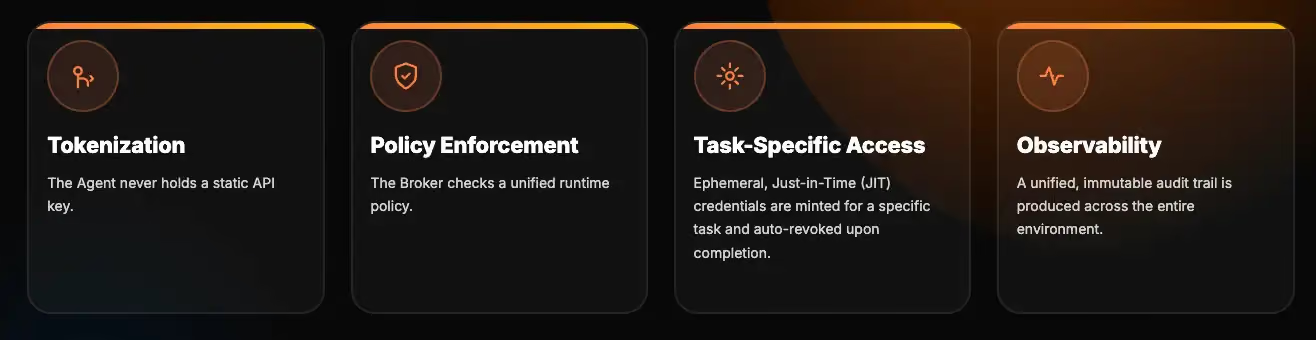
Identity in 2026 is fluid by design. This forces us to rethink the control plane itself. We need an Access Broker (often utilizing the Model Context Protocol) that sits between the agent and your corporate tools.
In this model:
- Tokenization: The Agent never holds a static API key.
- Policy Enforcement: The Broker checks a unified runtime policy.
- Task-Specific Access: Ephemeral, Just-in-Time (JIT) credentials are minted for a specific task and auto-revoked upon completion.
- Observability: A unified, immutable audit trail is produced across the entire environment.
This architectural shift moves us away from "trust but verify" toward a model of "verified intent." We are no longer securing a perimeter; we are securing a conversation.
5. Intent vs. Policy: The Skepticism Layer
Finally, we must acknowledge that humans are often the "weakest link" and can provide ambiguous or risky prompts. Our guardrails must act as a Skepticism Layer.
By implementing Human-in-the-Loop (HITL) controls for high-risk actions, we prevent "approval fatigue". We only trigger friction when an agent’s request carries a high blast radius—such as deleting cloud resources or accessing financial PII. In my world, that means an AI can summarize a patient’s history, but it cannot authorize a prescription change without a human signature.
The Policy of Preventative Inaction
Securing Agentic AI isn't about building bigger walls; it's about building context-aware gates. An agent may not injure a system, or through inaction, allow a system to come to harm—even if commanded to do so by a human whose "intent" contradicts "policy".
If a human commands an action that violates established safety guardrails, the agent’s default state must be a "safe fail." The need is to move toward a world where our systems understand not just who is asking, but why—and have the sovereignty to say "no" when those two things don't align.